
Close
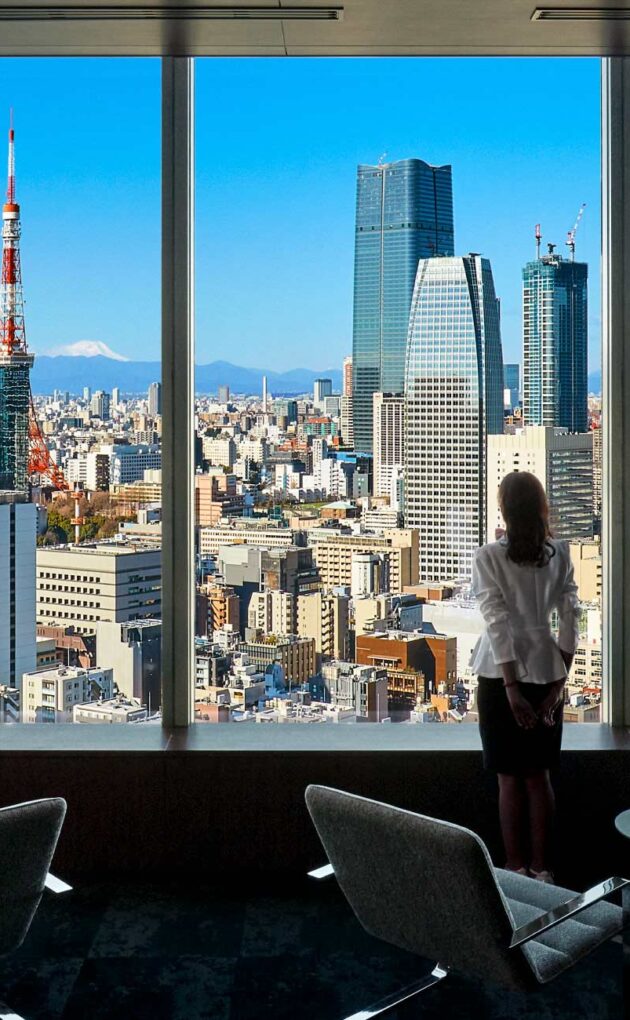
Launched by Park Hotel Tokyo in 2012, the “Artist in Hotel” project invites artists to stay at the hotel and transform a guest room into a work of art, using its walls and interior as their canvas.
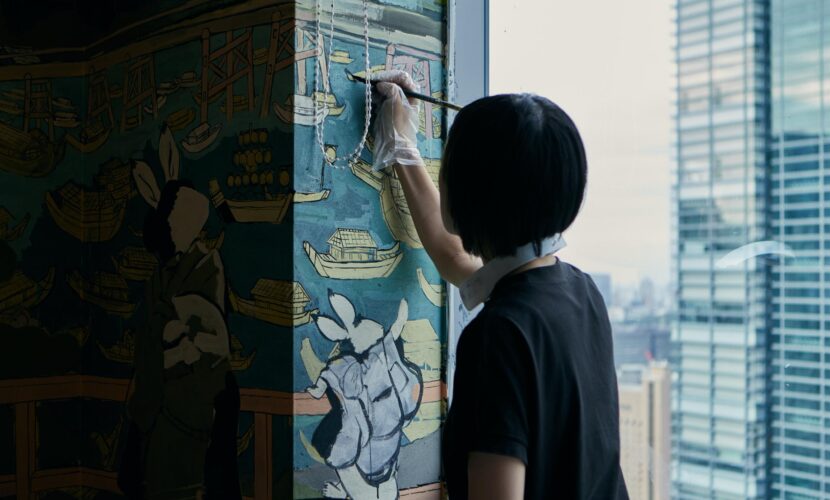
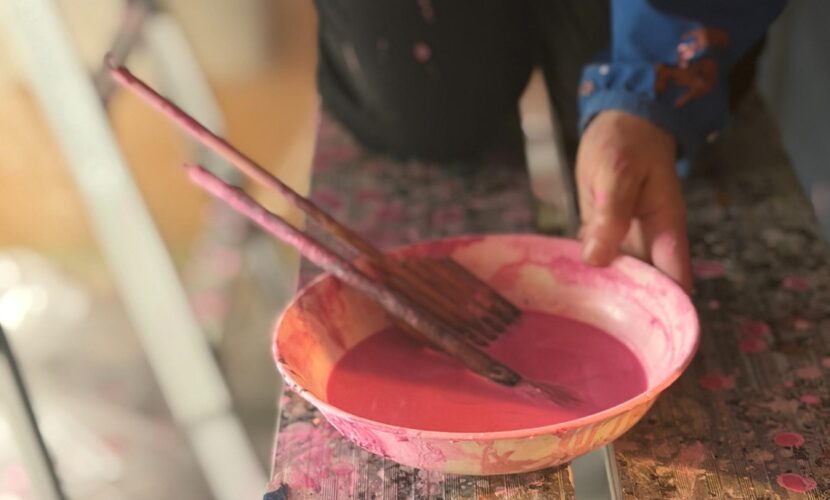
For this interview, we visited an Artist Room that is currently taking shape. As artist Nozomi Tanaka continued painting directly onto the walls, she spoke with us about the ideas behind the work, her thoughts on the creative process, and the discoveries that can only emerge while a room is still in progress.
Q. Could you tell us about your journey so far, what first led you to art, and some of your earliest creative experiences?
I have loved drawing since I was little, and I used to draw almost every day. I also loved making things out of cardboard. There were always plenty of boxes at my parents’ home, so I would use them to make toys. I would also copy characters from my favorite games and manga. Those were all part of my everyday life.
I loved video games and computers, but I also enjoyed being active and playing sports. I practiced rhythmic gymnastics, and I think the physical awareness I developed through it, such as an understanding of movement and how muscles work, has also influenced the way I draw.
Q. What path did you take after entering high school?
For some time after starting high school, I was unable to picture my future. Although I attended a public college-preparatory high school, I struggled because I did not know what kind of work I wanted to do or even what gave life meaning.
Even so, I thought that if I had to choose a path, I should at least go somewhere that would allow me to do what I loved. That led me to Tohoku University of Art and Design.
For about the first three years, I was mainly occupied with completing assignments. However, as I studied folklore and architecture, I learned about and experienced traditional houses that had long existed in local communities, as well as festivals rooted in particular regions. Through this, my interest in “place” and “everyday life” gradually deepened.
By my fourth year, I had begun to see what I truly wanted to paint. That was when I finally felt I was able to create something I could call a work of art.
Q. After entering graduate school, you also participated in community-based art projects in various parts of Japan.
Yes. In graduate school, I wrote my thesis on the theme of “placeness art.”
As I became involved in community projects, I began to feel uncomfortable with the way the word “region” was often treated as synonymous with “the provinces,” and how remote or depopulated areas such as those in Tohoku could be viewed as something to be consumed.
For that reason, I deliberately explored the idea of “placelessness,” looking at developed areas and roadside landscapes as subjects for both research and artistic practice.
Rather than using art simply to promote the character of a region, I wanted to create works that could pose questions arising from a particular place, questions that art itself is uniquely capable of asking.

Q. Could you tell us about the theme of this Artist Room and why you chose rabbits as its central motif?
The theme is the many shades of brown and gray that were popular during the Edo period.
At the time, official regulations prohibited people from wearing anything too extravagant. In response, ordinary people in Edo subtly mixed brown with hints of blue or red, finding discreet ways to enjoy fashion within an otherwise restrained palette.
I was fascinated by this history. I want to express something of the spirit, wit, and quiet rebelliousness of the people of Edo.
The compositions are based on famous ukiyo-e prints, including works by Utagawa Hiroshige, but I have deliberately replaced the human figures with rabbits.
Q. Why did you choose rabbits rather than people?
When the figures are human, it can be difficult for viewers to see the scenes as fiction. By creating fiction based on real events and replacing the people with rabbits, I thought the work might be more readily received with a sense of humor.
I began drawing rabbits during my third year at university. In one of my classes, I learned about how the depopulation and aging of satoyama communities can cause cultivated land to return to deep forest. When the gradual transition between mountains and cities disappears, wild animals such as bears may begin to enter urban areas.
At the time, I made a painting in which animals that had once found food in the satoyama began cultivating fields for themselves. I hoped the work might encourage people to think about issues arising in communities close to them.
I drew many different kinds of animals, but rabbits were the easiest for me to depict. Rabbits are also generally seen as vulnerable creatures, which made them feel like the right choice. I have continued painting them ever since.
Q. How far along do you feel the room is at this point?
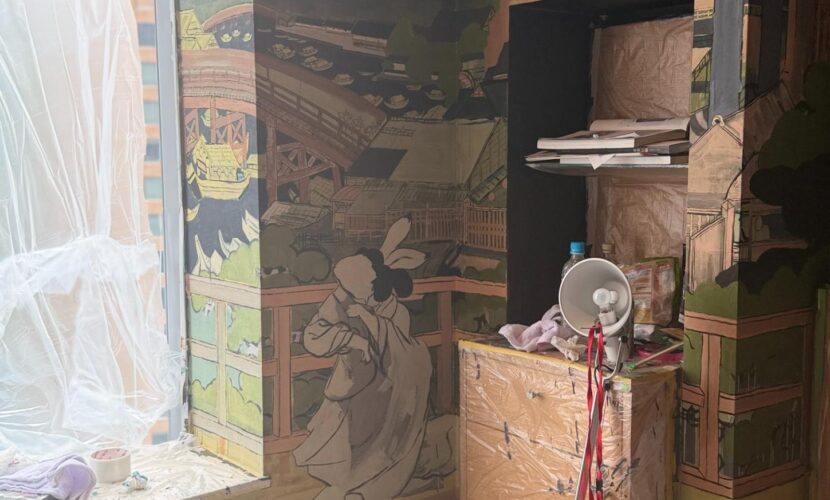
About halfway, I think. I can already see the overall finished form fairly clearly in my mind.
Q. Of everything you have painted during this stay, which part do you like best?
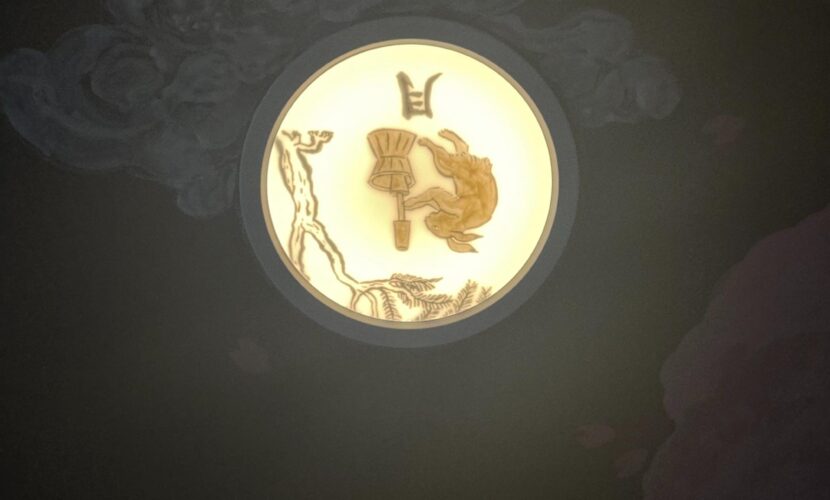
The area where I have turned the light fixture into the moon.
I was told that I could even paint on the reverse side of its white cover, and that gave me the idea. It was not part of my original plan.
I also painted the edge of the mirror black to match the mirror in the bijin-ga portrait, and used black on the desk and drawers as well. These are all ideas that emerged naturally as I worked.
Q. Are there particular challenges or pleasures that come from working on a room that is still in progress?
Painting three-dimensional areas such as the ceiling is difficult. I have to think about how to handle the points where one wall meets another. At the moment, I am using clouds to cleverly disguise those transitions and connect the surfaces.
I usually work on flat sheets of paper or panels, so standing and painting directly onto the walls of an entire room is physically demanding. Sometimes my lower back begins to hurt.
At the same time, I am really enjoying the process of creating a contrast between the impression guests receive when they first enter and the livelier atmosphere they discover as they move farther into the room.
I have also incorporated the nighttime view outside the windows into the scene, including a rabbit that appears to be gazing out at the actual cityscape.
Q. How does painting in a hotel guest room differ from working in your usual studio?
It is completely different.
One of the most important things about staying here has been the opportunity to walk around and explore the surrounding area. By visiting places such as Daimon, Tokyo Tower, and Hamarikyu Gardens on foot, I began to feel almost as though I were actually living in Tokyo.
When I first arrived, a festival happened to be taking place, and I saw a procession carrying a mikoshi, or portable shrine. That was a great source of inspiration and has influenced the sense of liveliness in the painting.
It reminded me how important it is to walk through a place, experience it for myself, and paint only after gaining a genuine sense of it.
Q. What does a typical day look like while you are working here?
I usually have breakfast and begin painting at around 9:30 or 10:00 a.m. I paint until about 4:00 p.m., then go out for something to eat.
After returning, I either continue painting or, if I am tired, go to sleep. In the evening, I often go to the Shimbashi area. There are plenty of restaurants within walking distance, so I find myself going to Shimbashi most of the time.
Q. What is your impression of the hotel?
I have not stayed at enough art hotels to make a comparison, but as you would expect from an “art hotel,” it is wonderful to encounter different works of art every time I visit.
I often find it difficult to make time to go to museums. Here, however, I can see works by many different artists within the hotel itself, and I sometimes discover artists whose work I did not know before.
I find it especially interesting to encounter works by such a wide range of artists in a setting that is deliberately not a white-cube gallery.
Q. What kind of experience would you like future guests staying in this room to have?
I hope they will feel as though they have been sightseeing through the paintings.
I would also be delighted if the places depicted in the room, such as famous locations that might appear in ukiyo-e prints, inspire guests to visit those places in person and learn more about them.
Q. Park Hotel Tokyo welcomes many guests from overseas. Do you have a message for them?
One morning, I went to breakfast wearing the clothes I had been painting in. A guest from overseas who was sitting next to me asked, “Are you an artist?”
I felt sorry that I was unable to speak with them in English, but I would love for that person to see the room once the painting is complete. I hope they might come across it somewhere one day.
Q. Finally, could you share a message for everyone looking forward to the room’s completion?
I’ll do my best!
By the time the work is finished, I hope the room will have become a space in which the “Tokyo” I experienced during my stay has fully emerged.

Born in 1989. Doctor of Art and Design, artist, and full-time lecturer in the Department of Life Design, Faculty of Life Design, Tohoku Institute of Technology (since April 2023).
Tanaka’s practice focuses on “place,” understood as the environment surrounding everyday life, including food, clothing, and shelter, together with its broader context. Her works explore questions that arise through her engagement with particular places.
Drawing on firsthand experiences, archival and literary research, and oral interviews, she examines the relationships between people and place. She expresses her findings through painting, essays, animation, and other media.
She also analyzes and explores the relationship between art and community development through creative activities rooted in local areas.
Member of the Society for Design and Art Fusing with Science and Technology, and the Miyagi Traditional Crop Research Society.